
Nancy D’Alesandro
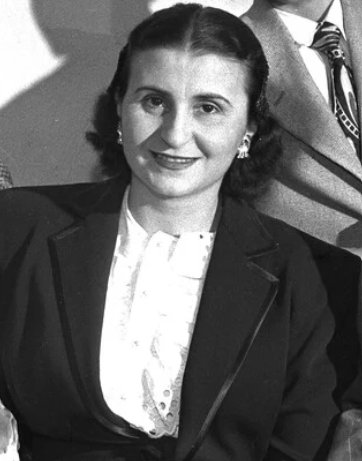
Nancy D’Alesandro (1909-1995) Born in Fornelli, Italy, in 1909 as Annunciata Lombardi, D’Alesandro grew up in Baltimore’s Little Italy. After graduating from the Institute of Notre Dame, she became an auctioneer for A. J. Billig and Co. Auctioneering in the early 1920s, at a time when female auctioneers were virtually unheard of. She married Thomas D’Alesandro Jr., then a Maryland state delegate, in 1928, and became deeply involved in civic and political life during his service as U.S. Congressman (1939–1947) and Mayor of Baltimore (1947–1959).
Described by TIME Magazine’s Molly Ball as “a one-woman social service agency,” D’Alesandro worked tirelessly over decades to help the immigrant community and low-income Baltimoreans. She personally assisted residents in securing housing, registering for public assistance, accessing medical care, and finding employment. During the Great Depression, she kept a pot of stew simmering at all times to feed anyone in need. A 1948 Baltimore Sun article described her phone number as “the hardest number in town to get,” reflecting the sheer number of people who sought her help. The Sun also called her “Baltimore’s first hands-on first lady” for the central role she played in managing constituent services and political affairs during her husband’s twelve years as mayor. As an immigrant herself, D’Alesandro’s fluency in Italian was a critical tool in reaching and serving immigrant communities.
Beyond her social services work, D’Alesandro was a skilled political strategist and operative, serving as the architect of her husband’s political career and maintaining the relationships that sustained Baltimore’s Democratic political machine throughout the 1950s. She transformed the Baltimore Democratic Women’s Club, which she ran from her basement, into a citywide political powerhouse, mobilizing hundreds of women to organize across Baltimore and expand female participation in politics. Her son, Mayor Thomas D’Alesandro III, described her as “the true politician of the family.” She was a vocal advocate for affordable housing and the dignified treatment of immigrants.
D’Alesandro was also an entrepreneur and innovator. She founded the Velvex Beauty Company and invented and patented one of the first devices to apply steam to the face, an early predecessor to modern at-home facial steamers, which she sold along with creams and oils at her shop in Little Italy. She was a published poet and served on the boards of the Young Women’s Christian Association and the American Red Cross Home Nursing Association.
The mother of seven children, D’Alesandro was especially influential in shaping the political life of her youngest child and only daughter, Nancy D’Alesandro Pelosi, the first woman Speaker of the U.S. House of Representatives. Pelosi has credited her mother with teaching her the fundamentals of politics, noting, “What you have to know about my mother is that she was a feminist long before she ever heard the word.” Pelosi added, “If she were starting out now, I’m sure she would be President of the United States.”
Upon D’Alesandro’s death, Baltimore Sun columnist Michael Olesker wrote, “Nancy D’Alesandro left the headlines to others. But she was there, and she played the game with muscle, and the world moved a little when she did.”