Protecting Maryland Benefit Programs
The Maryland Department of Human Services (DHS) aggressively pursues opportunities to assist people in economic need, provides preventive services, and protects vulnerable children and adults in each of Maryland’s 24 jurisdictions. We take this mission seriously and are committed to fiscal stewardship of all of our programs
One of DHS’ responsibilities is to monitor and prevent fraud, waste, and abuse. We are dedicated to protecting taxpayer dollars, maintaining public trust, and ensuring vital resources remain available to the eligible Maryland individuals and families who need them.
What We Watch For
- Fraud: Occurs when an individual or entity knowingly lies, provides false statements, or deliberately misrepresents facts to receive benefits or payments they are not legally entitled to.
- Waste: Involves the overuse or inappropriate use of services and resources that results in unnecessary costs to the state.
- Abuse: Practices that are inconsistent with sound fiscal, business, or program rules, resulting in unnecessary costs or a loss of integrity to the program.
Examples of Public Benefits Fraud, Waste, and Abuse
- Eligibility Misrepresentation: Concealing or failing to report household income, assets, employment, or household members on an application.
- Food Supplement Trafficking: Buying and selling Supplemental Nutrition Assistance Program (SNAP) benefits for cash or other unauthorized items, as well as skimming and cloning of Electronic Benefit Transfer (EBT) cards used to steal benefits.
- Out-of-State Violations: Permanently living in another state while continuing to collect public assistance benefits from Maryland.
How You Can Help
If you suspect an individual or business is committing fraud or suspect any practice that constitutes waste or abuse of a public benefits program, we encourage you to report it immediately. All reports are handled with strict confidentiality, and you have the right to remain completely anonymous.
How to File a Report
- Call Maryland DHS at 1-800-332-6347 and select the Welfare Fraud Hotline option
- Submit an online form: Report Fraud
Maryland DHS’ Office of the Inspector General handles all reports submitted through the hotline or online.
How We Stop Fraud: Our Tools
DHS uses advanced technology and verification systems to prevent fraud and protect public benefits programs. Here is how we safeguard program integrity.
Secure EBT Cards

EBT is the secure system that allows Maryland Supplemental Nutrition Assistance Program (SNAP) and Temporary Cash Assistance (TCA) customers to access their benefits electronically.
Each month, benefits are deposited into a central account. Customers use their Maryland EBT card with a personal PIN to buy groceries at authorized retailers or withdraw cash at ATMs to pay for rent, utilities, or other essential household needs.
During summer 2026, Maryland became the fourth state in the nation to issue new, more secure EBT cards for customers. These cards use Europay, Mastercard, Visa (EMV) chip and tap technology, similar to bank-issued credit or debit cards. The upgrade protects customers from fraud, including card skimming and other forms of benefit theft.
More information about Maryland’s transition to more secure EBT cards can be found on DHS’ EBT card website.
Universal Identity and Eligibility Verification
We use a variety of data sources to verify applicants’ identity, income, and other eligibility information to support accurate and timely eligibility determinations. Identity and eligibility verifications are conducted for each member of the household applying for benefits.
- Identity and Social Security Verification: We verify an individual’s identity, Social Security number, and applicable federal benefits against official federal records to confirm an applicant’s identity and accurately determine eligibility and income.
- Comprehensive Federal Eligibility Verification: We conduct additional federal data matches to validate identity, Social Security information, and benefit data.
- Immigration Status Verification: We verify immigration status with federal records to ensure that benefits are provided only to individuals who meet eligibility requirements.
- Health Coverage Verification: We verify whether an individual is already enrolled in active public health coverage to prevent duplicate or overlapping benefits.
Income, Employment, and Asset Verification
These verification processes help ensure benefits are calculated using accurate, current household financial information.
- Employment and Wage Verification: We verify wages, employment status, and hire or termination dates using employer-reported payroll information to ensure household income is accurately calculated.
- Unemployment Benefit Verification: We verify unemployment insurance compensation and reported earnings to accurately assess a household’s current financial circumstances.
- New Employment Verification: We receive notifications when household members begin new employment, allowing us to update eligibility and benefit amounts as income changes.
- Asset Verification: For certain Medical Assistance programs, we verify financial assets to determine eligibility for long-term care and other means-tested benefits.
Residency, Program Integrity, and Cross-State Verification
These verification processes help ensure benefits are issued only to eligible individuals and prevent duplicate participation or fraud.
- Program Disqualification Verification: We verify whether an individual has an active disqualification for fraud or an intentional program violation in another state to prevent ineligible participation in Maryland benefit programs.
- Interstate Benefit Verification: We determine whether an individual is receiving public assistance in another state to prevent duplicate enrollment.
- Cross-State Eligibility Verification: We conduct additional interstate data matches to identify households that may be receiving benefits in more than one state.
- Federal Employment and Benefit Verification: We verify federal employment, military service, retirement, and veterans’ benefits to ensure household income is accurately calculated.
- Incarceration Verification: We verify incarceration records to ensure benefits are not issued to individuals who are ineligible while they are incarcerated.
- Death Record Verification: We verify death records to prevent benefits from being issued or continued after an individual’s death.
Audits and Investigations
State and federal agencies audit DHS to ensure the program follows all laws and that funds are used properly.
- Office of Legislative Audits: View OLA audit reports.
- DHS Office of the Inspector General:
- The OIG Bureau of Audit Services conducts financial, compliance, and performance audits of DHS statewide operations and the Local Departments of Social Services.
- Driven by proactive strategies and fraud reports from various sources, including the general public, the Bureau of Investigative Services conducts thorough investigations.
- U.S. Department of Health and Human Services OIG: Search HHS OIG reports for federal audit results.
Understanding the SNAP Payment Error Rate
What is the SNAP payment error rate?
The SNAP payment error rate measures how accurately state agencies determine eligibility for the program and the correct benefit amounts.
It is a combination of
- Underpayments: when a household receives less benefits than they are entitled to; and
- Overpayments: when a household receives more benefits than they are entitled to.
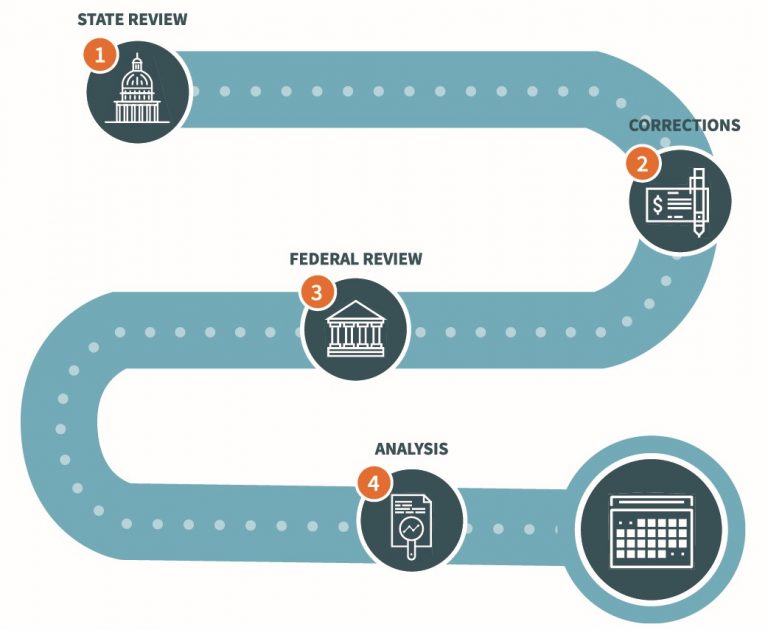
Every June, the United States Department of Agriculture (USDA) analyzes the final data collected from the states and uses that to determine national and state payment error rates.
Are SNAP payment errors the result of fraud?
No. The SNAP payment error rate measures the accuracy of SNAP eligibility determinations and benefit amounts issued to eligible households. It is not a measure of fraud by the administering agency or by SNAP participants.
Payment errors can result in either overpayments or underpayments and are often caused by unintentional administrative errors or changes in household circumstances that were not reported or acted upon in a timely manner.
Additional information on SNAP payment error rates can be found on the USDA’s website.
What is Maryland’s SNAP payment error rate?
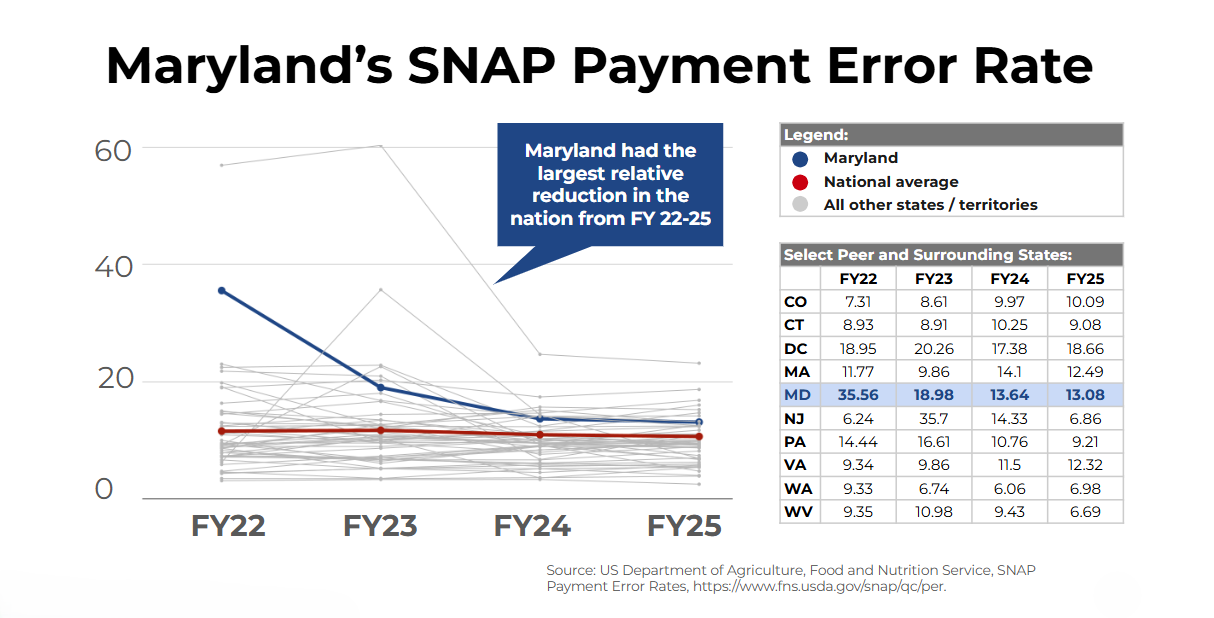
- FFY 2025: 13.08%
- FFY 2024: 13.64%
- FFY 2023: 18.98%
- FYY 2022: 35.56%
Since 2022, Maryland has the largest relative reduction in payment error rate of any state.
What is Maryland doing to improve its SNAP payment error rate?
Maryland has deployed a comprehensive strategy focused on improving its SNAP payment error rate, including:
Investing in our team by filling vacancies and training staff.
- Since January 2023, DHS has hired nearly 200 new caseworkers and supervisors statewide, reducing the program staff vacancy rate by almost three-quarters.
- DHS continues to prioritize recruitment, retention, and training to fill every vacancy and ensure employees have the knowledge and tools needed to serve Maryland families and accurately deliver benefits.
- In May and June 2026, DHS hosted four regional Payment Accuracy Summits to provide caseworker training, share best practices, and build statewide alignment around payment accuracy improvement strategies.
Simplifying complex procedures to reduce administrative burdens for both staff and customers.
- This includes:
- Improving the Maryland Benefit Reviews to streamline processes and reduce opportunities for error;
- Partnering with Code for America to redesign redetermination forms and simplify customer notices;
- Increasing benefit access by making redetermination available on the customer portal; and
- Collaborating with the Public Benefit Innovation Fund to streamline work verification and document submission processes.
Using advanced data tools to proactively manage and intercept payment errors before they happen.
- The department is developing a data dashboard to analyze and pinpoint high-risk cases. DHS has also teamed up with U.S. Digital Response and the University of Maryland to conduct deeper analyses of error trends and root causes.
- DHS remains committed to working closely with the USDA and frontline teams to protect program integrity, eliminate operational barriers, and ensure that customers receive the benefits that are lawfully entitled to.