
About The US Refugees Admissions Program (USRAP)
Overview
The United States Refugee Act of 1980 incorporates the United Nations definition of “refugee” and standardizes resettlement services for all refugees admitted to the U.S. The Refugee Act provides legal basis for the current U.S. Refugee Admissions Program and is administered by the Office of Refugee Resettlement (ORR) in the U.S. Department of Health and Human Services (HHS), in conjunction with offices in the U.S. Departments of State (DOS) and Homeland Security (DHS), through the Program of Initial Resettlement (PIR).
For more information about federal refugee processing, visit:
https://www.uscis.gov/humanitarian/refugees-and-asylum/usrap
For more information about the Program of Initial Resettlement, visit:
https://acf.gov/orr/programs/refugees/pir
Determining Refugee Resettlement Arrivals
The President, in consultation with Congress, determines the annual ceiling for refugee arrivals through the U.S. Refugee Admissions Program – this is called the Presidential Determination or refugee ceiling. Over the last few years, admission ceilings have ranged from 17,500 to 125,000. The refugee ceiling does not include asylees, humanitarian parolees, nor any other special populations.
Refugee admissions are determined based on consultations with stakeholders and Resettlement Agencies, taking into consideration local capacities as well as economic conditions, availability of housing, public transportation, jobs, and other resources for new groups. Reception and placement services are governed by cooperative agreements with ORR. While MORA administers programming to provide support services, financial and medical assistance to eligible refugees, the state has no role in the administration of USRAP and PIR processes.
Refugee Processing
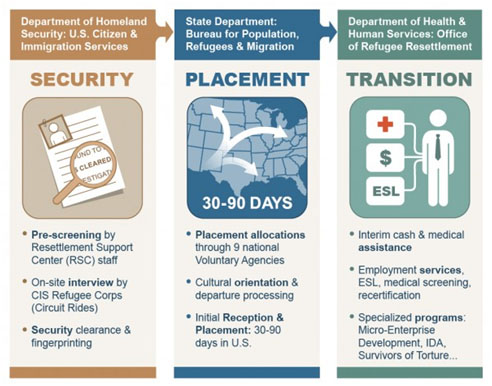
Once approved for resettlement through USRAP, refugee families undergo medical exams. Once all security and health checks are complete, refugees are scheduled for travel to the United States. They undergo placement through a local affiliate of a national Resettlement Agency, at which point they begin Initial Reception & Placement (R&P) processes and transition to their new lives in the United States. This is further illustrated by the graphic below:
What is the difference between refugees, immigrants, and asylees?
Refugees are forced to flee their homes and seek safety in another country, often times without warning. Immigrants make a conscious decision to leave their countries to seek a better life elsewhere. While immigrants may return to their home country, refugees often cannot.
Refugees apply for protection while overseas and enter the U.S. with approved refugee status and documentation, while asylees request protection and may be granted asylum only once they are within the U.S. Asylum seekers request asylum upon entering the United States or traveling to a U.S. port of entry. Asylum seekers must apply for asylum through U.S. Citizenship & Immigration Services (USCIS)
How does the U.S. determine if a refugee is eligible for resettlement?
Applicants for refugee admission to the U.S. must satisfy the following criteria:
- Meet the definition of a “refugee” as determined by the U.S. government
- Are determined by the President to be of special humanitarian concern to the U.S.
- Be otherwise admissible under U.S. law
- Not be firmly resettled in any foreign country
- Pass security and medical clearance
Although a refugee may meet the above criteria, the existence of the U.S. Refugee Admissions Program does not create any entitlement for that person to be admitted to the U.S.
In determining each applicant’s request for resettlement, an evaluation is made whether for the applicant may be qualified for the 3 internationally accepted durable solutions for refugees:
- Voluntary repatriation: Refugees return to their former country of nationality when conditions prevail that allow for a safe return
- Local integration: Local settlement and integration of refugees in their country of first asylum upon receiving agreement from the host country
- Resettlement: Most frequently used for refugees whose life, liberty, safety, health or human rights are at risk in the country from where they have sought refuge. Resettlement to a third country becomes the primary objective or priority when there is no other way to guarantee the legal or physical security of the refugee.
Most refugees and displaced persons return to their communities when peace and stability return to their country. When conditions in countries of origin remain unstable or there is a danger of persecution upon repatriation, some refugees are able to stay in a refugee settlement in another country. Resettlement in a third country, such as the United States, is the last option, and is available to only a tiny fraction of the world’s refugees.